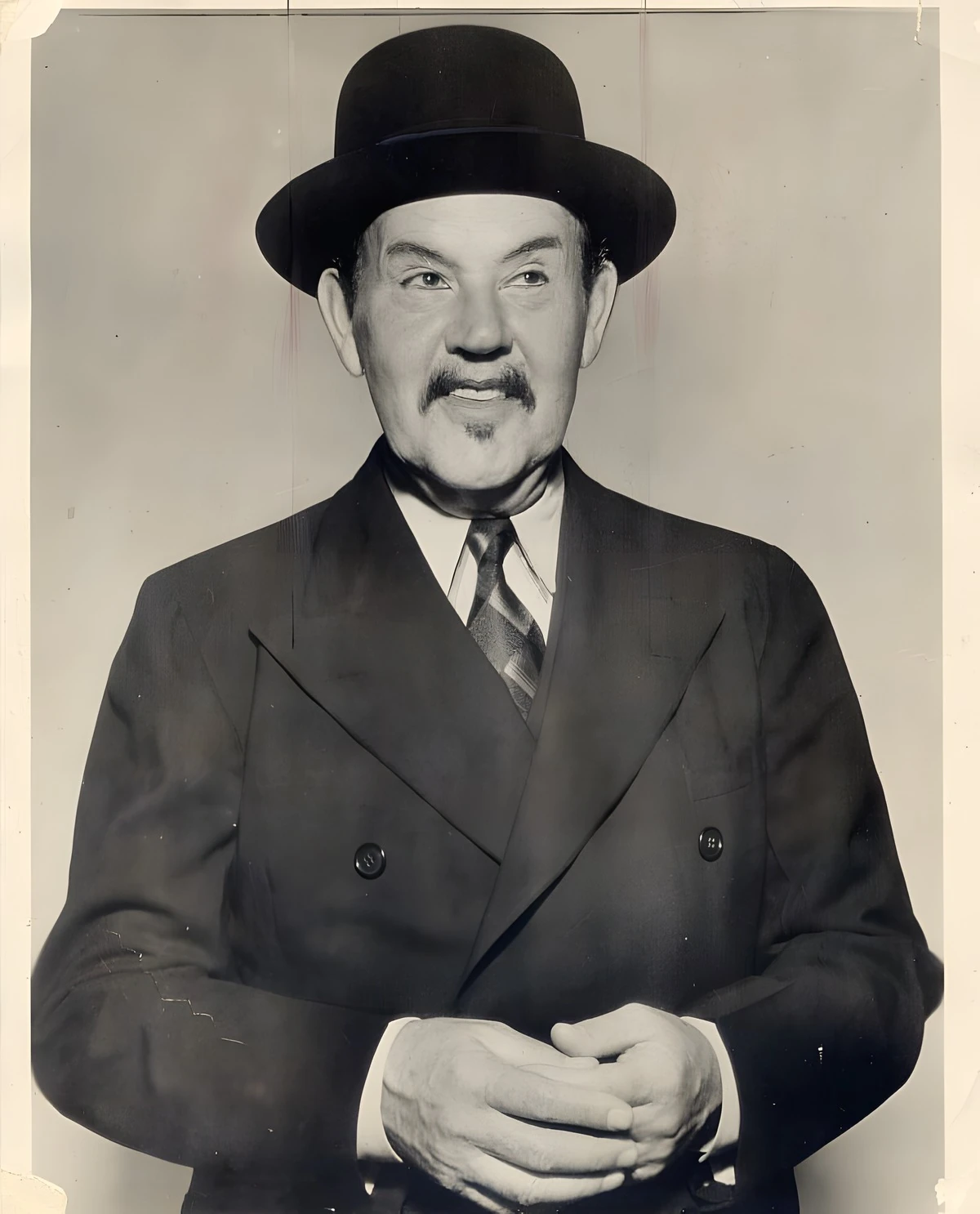
Charlie Chan
Where It Came From
Charlie Chan had already proven himself a reliable property before radio ever touched him. Earl Derr Biggers created the character in a series of novels beginning with The House Without a Key in 1925, and a long run of B-grade films had been rolling since 1931. By the time the Blue Network put him on the air in December 1932, audiences already knew what they were getting: a methodical, aphorism-dispensing Honolulu detective with a gift for seeing what others missed.
That first run was part of the Esso Oil Five Star Theater, a block that featured a different entertainment each weekday at 7:30, with Chan in the Friday slot and some Saturday broadcasts near the end. The episodes ran 30 minutes, and rather than original stories, the show adapted three Biggers novels directly — The Black Camel, The Chinese Parrot, and Behind That Curtain — each serialized across multiple installments. Walter Connolly played Chan during this run, which ended May 26, 1933. Biggers himself did not live to see it finish; he died of a heart attack in Pasadena on April 5, 1933, at 48.
Six Runs, Four Networks
What's unusual about Charlie Chan on radio isn't any single season — it's the persistence. The character came back again and again across different networks and formats over sixteen years, produced throughout for the 20th Century Fox Radio Service.
After the Blue Network run ended in 1933, Mutual picked the show up in September 1936 for a 15-minute weekday continuation at 5:15, running until April 1938. Walter Connolly returned as Chan, with the serial dramatizing Biggers' final novel Keeper of the Keys as "The Landini Murder Case," originating from Los Angeles. Then a gap of several years, and NBC brought Chan back in the summer of 1944 as a Thursday-night replacement for The Bob Burns Show — 30-minute episodes sponsored by Lever Brothers advertising Lifebuoy Soap. This was also when the show took on the title The Adventures of Charlie Chan.
The cast that carried the show through its later years came together with that 1944 NBC run. Ed Begley stepped into the lead role, and Leon Janney joined as Lee Chan, the Number One Son. Both continued when the show moved to the Blue Network that fall, then to ABC in 1945, and finally back to Mutual for the last run from August 1947 to June 1948, retitled The Incomparable Charlie Chan and sponsored by Pharmaco. During that final Mutual stretch, Santos Ortega also played Chan alongside Begley.
The surviving audio is patchy. Roughly 60 recordings totaling about sixteen hours and twenty minutes are known to circulate, with the majority of the serialized chapters believed lost. What does survive includes "The Murder of Colonel Willoughby" from the Connolly Mutual era and "The Man Who Moved Mountains" and "The Case of the Marching Ants" from the Ortega run.
Walter Connolly, the Original Radio Chan
Connolly was a serious stage actor before he was a radio detective — 22 Broadway productions between 1916 and 1935, with training at St. Xavier College and the College of Music of Cincinnati, his hometown, and a stint in the U.S. Marines during the First World War in between. He was best known on screen as the millionaire father in Frank Capra's It Happened One Night (1934), and he had a particular line in fictional sleuths: Nero Wolfe in The League of Frightened Men (1937) and the title role in Father Brown, Detective (1934). On radio he carried both the 1932–33 Blue run and the 1936–38 Mutual continuation. He died of a stroke in Beverly Hills on May 28, 1940, at 53 — so by the time Begley took the role in 1944, the original radio Chan was already four years gone.
Ed Begley in the Role
Radio Life had a specific opinion about Ed Begley's Chan, calling his portrayal "a good radio match for Sidney Toler's beloved film enactment." The magazine pointed to a line like "These ancient eyes perceive a cartridge of unusual caliber" as representative of how Begley delivered the character — measured, slightly formal, with just enough theatrical weight to keep the detecting feel intact without tipping into parody.
The final Mutual run had a defined creative team: John Cole directed and Alfred Bester wrote the scripts. Bester, who would go on to other work in science fiction, gave the show a consistent voice during those last two seasons. Leon Janney stayed with the role of Number One Son across all the later runs, providing continuity from 1944 through the final broadcast on June 21, 1948.
What Chan Was, and Wasn't
Biggers had a stated intention when he invented the character. He'd read a 1923 newspaper item about two Honolulu detectives, Chang Apana and Lee Fook, and built Chan as a deliberate counter to the era's reigning Chinese-villain template. "Sinister and wicked Chinese are old stuff," he wrote, "but an amiable Chinese on the side of law and order has never been used." That framing — Chan as the anti–Fu Manchu — is part of why the property endured. It's also why the property became controversial, because the alternative Biggers built carried its own freight.
The "Confucius say" aphorisms that became the character's signature, for instance, weren't in the novels at all. They were a film addition, layered on by screenwriters and then adopted by the public as the essence of Chan. Scholar Huang Yunte has argued that those "colorful aphorisms" display "amazing linguistic acrobatic skills" and that Chan "imparts as much insult as wisdom," likening them to the signifying monkey of African American folklore. Critic Sandra Hawley made a related point about Biggers' physical description of Chan — fat and soft-stepping, deliberately nonthreatening — arguing that it let Biggers position Chan as the opposite of Fu Manchu while still leaning on "supposedly Chinese characteristics such as impassivity and stoicism." The character was an improvement on what came before and a problem in his own right, and both things have been true the whole time.
After 1948
The American radio run ended in June 1948, but the character kept finding new formats. An Australian radio series, also called The Adventures of Charlie Chan, premiered on station 2UW Sydney on January 21, 1950, with William Rees as Chan and Rodney Jacobs as Number One Son. In 1956–57 came The New Adventures of Charlie Chan, a 39-episode syndicated TV series starring J. Carrol Naish, filmed in England and oddly relocating Chan to London; the ratings were poor and it was canceled.
In the 1970s, Hanna-Barbera produced the animated Amazing Chan and the Chan Clan, with Keye Luke — who had played Lee Chan in the 1930s and '40s films — voicing Charlie himself, becoming the first actual Chinese performer to play the character. A 1981 feature, Charlie Chan and the Curse of the Dragon Queen with Peter Ustinov and Angie Dickinson, was protested on the way out by a group calling itself C.A.N. (Coalition of Asians to Nix) and judged an abysmal failure. No Chan film has been made since. The character has lived on mostly in print: a Dennis Lynds paperback, Charlie Chan Returns, in 1974; new short stories in Ellery Queen Mystery Magazine through the decade; and, after the earliest Biggers novels entered the public domain in 2021, two new Chan novels in the 2020s.